HEXA for public safety
The bottleneck in emergency response isn’t seeing the scene. It’s getting a trained person there. HEXA flies a paramedic, firefighter or officer over traffic and straight to the call.
The problem
Ground response runs on indirect roads, increasingly choked with traffic. Adding stations or patrols to close the gap quickly hits a practical limit. So response goals are set by what the road network allows, not by what’s needed to change outcomes.
In a cardiac arrest, every minute without CPR or a defibrillator costs about 5 points of survival: from 67% at best to none after about 12 minutes, and brain damage starts within 4. The AHA’s maximum is 5 minutes. In U.S. cities and suburbs, half of EMS responses arrive within about 6 minutes of the 911 call, but goals allow 9, a quarter miss even that, and 1 in 10 takes 13 or more.
EMS Cardiac arrest, U.S. cities and suburbs
Violent crimes happen fast. A few minutes decide whether officers arrive while one is in progress and can still change the outcome, or arrive afterwards to gather evidence. Take an active shooting: most are over within 5 minutes, yet city goals allow an average of 8, typical responses take about 10, and 1 in 10 takes about 18 or more. Even after the fact, every 10% added to response time cuts the chance of solving the crime by about 5 percentage points.
Police Violent crime in progress · example: an active shooting (FBI data); response times in large U.S. cities
A room with modern furniture can go from a small fire to flashover, when everything in it ignites at once, in under 5 minutes. The national goal puts the first engine on scene within about 6½ minutes of the 911 call. Half of responses arrive within about 5 minutes of the call, and 1 in 10 takes 11 or more.
Fire A house fire in a room with modern furniture · response times for U.S. structure fires
Survival from a cardiac arrest with no CPR or defibrillation, Larsen et al., Annals of Emergency Medicine 1993 (1,667 witnessed arrests in ventricular fibrillation, King County, WA: 67% at collapse, less 2.3 points a minute to CPR, 1.1 to the first shock and 2.1 to advanced care, so 5.5 a minute with no help; these are the most survivable arrests, and overall survival is far lower). Brain damage starting about 4 minutes after collapse, and defibrillation within 3–5 minutes of collapse, American Heart Association. Both charts count from the emergency itself and assume about a minute before the 911 call. Police response time and crime clearance, Blanes i Vidal and Kirchmaier, Review of Economic Studies 2018 (about 300,000 crimes, Greater Manchester Police: a 10% longer response cut the likelihood of clearing the crime by 4.7 percentage points). Flashover, UL Fire Safety Research Institute, side-by-side tests of rooms with synthetic and natural furnishings (synthetic rooms flashed over between 3:20 and 4:50; natural rooms took more than 29 minutes). Fire goal, NFPA 1710 (64 s call processing, 80 s turnout and 240 s travel for the first engine, 90% of fires). Fire response times, U.S. Fire Administration, Structure Fire Response Times (2001–02 NFIRS data: half within about 5 minutes, 90% within about 11). Active shootings, FBI and Texas State University, A Study of Active Shooter Incidents in the United States Between 2000 and 2013 (of the 64 incidents with a known duration, 36% were over within 2 minutes and 69% within 5; the curve is 20% fewer each minute, which fits both). EMS goal, NFPA 1710 (advanced life support, 90% of calls; local standards vary). EMS times, Mell et al., JAMA Surgery 2017 (national 911 data, from the call: median about 6 min, 90% of responses within 12 urban and 14 suburban; the chart shows 13). The share of responses on scene at each minute assumes response times are log-normal through those numbers, for both EMS and police. Police, 2024–25 highest-priority goals (about 6–11 min) and averages (about 6–13 min) published by five of the largest U.S. city police departments, via city reports and local news; cities publish averages, not 90% times, and measures differ by city; the chart shows a goal of 8 and an actual average of 10. The police 90% time (about 18 min) is an estimate: a log-normal with the EMS times’ spread and a 10 minute average.
Works with your drone program
Drone-as-first-responder programs changed what command knows in the first minutes of a call. But a camera can’t start CPR, stop a bleed or make an arrest. HEXA is built to work alongside your DFR program, not to replace it.
Overwatch, situational awareness and a live feed to dispatch and responding units.
A trained, equipped paramedic or officer lands and starts intervening before the ground unit clears traffic.
Ambulances, engines and patrol arrive to a scene that’s already being worked.
The clock stops when a responder arrives. Response time is measured until a trained paramedic or officer reaches the scene. A drone overhead gives everyone on the way a head start on what they’ll find; getting hands there sooner is what moves the number.
Missions

Put a paramedic on a cardiac arrest, overdose or major trauma while the ambulance is still in traffic. Medics and firefighters fly the same aircraft from the same post.
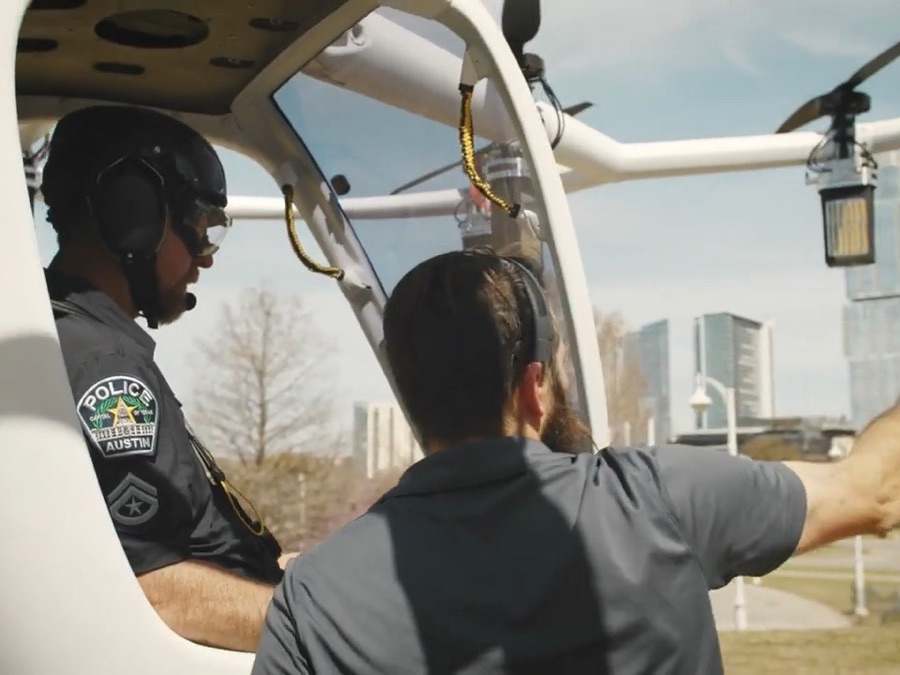
An officer on scene in minutes, not a feed. Cover more ground with the staff you have, and arrive while there’s still time to change the outcome.
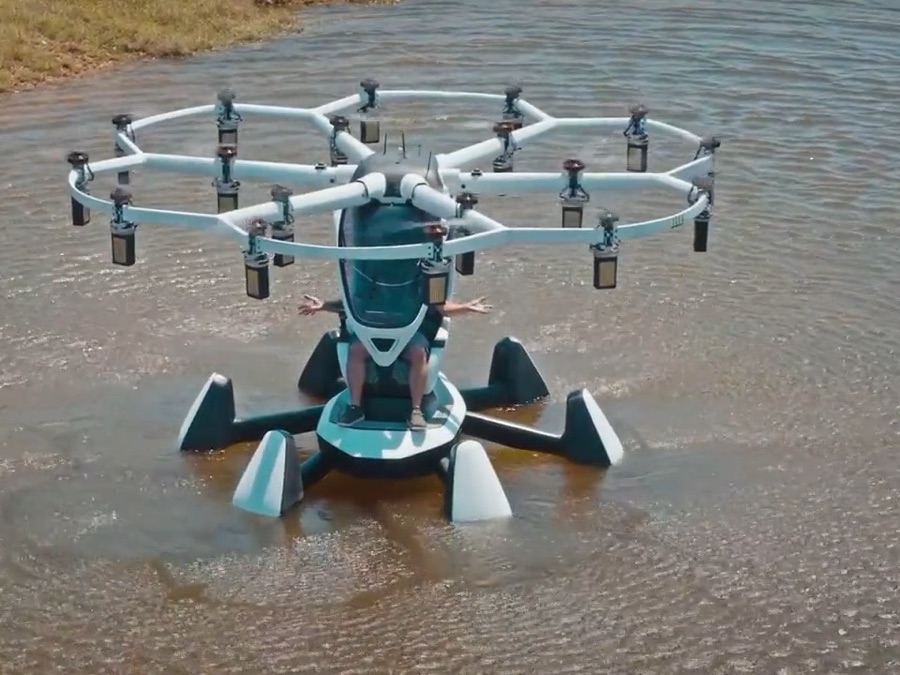
Water, flood and wilderness response where roads are cut. Amphibious floats, and a cargo configuration for supplies.
The value
Ground units follow roads and traffic. HEXA flies straight to the scene at 50 mph. The farther the call, the bigger the gap, and the long calls are the ones that push your EMS 90th percentile and your Priority 1 average past their goals.
Example call · Austin
On this call the roads wind × the straight line. Played at 1 second per minute.
The map couldn’t load in this browser. The times are for this example call.
That’s 6.7 minutes sooner for a paramedic to start CPR or stop a bleed, or for an officer to intervene. On a cardiac arrest without bystander CPR, survival falls about 5 points with every minute (from 67% at best); overdose, stroke, severe bleeding and violent incidents follow the same logic.
Most stations cover a first-due area only a few miles across. When the nearest unit is already on a call, the next available (second-due) unit responds from farther away, often from the next station over.
Each distance is a real street route from a public safety headquarters. Both launch in the same 1 min. The ground unit drives the street route at 28 mph. HEXA flies the straight line at 50 mph and lands in 1 min. Dispatch time is the same for both and left out.
U.S. EMS response times, Mell et al., JAMA Surgery 2017 (urban median 6 min, 90th percentile 12 min; suburban 90th percentile 14 min). Survival per minute, Larsen et al., Annals of Emergency Medicine 1993 (67% at collapse, about 5.5 points less each minute with no CPR or defibrillation). HEXA times are LIFT model estimates at typical utilization, to be validated in AirFirst trials; we model them on your own call data. All figures are planning-level.
The cost
A medical helicopter costs so much that it’s held back as a last resort: in most systems it’s called only after a ground crew has reached the patient and decided air transport is needed. Police air support works the same way: few agencies have a helicopter, and those that do keep it for pursuits and searches, not for getting an officer to a call. HEXA costs about what a ground ambulance run does, so an air response can be the first one sent, not the last.
These services aren’t substitutes. A drone sends a camera, HEXA sends a responder who can act, and an ambulance or helicopter transports the patient. HEXA works alongside both.
Ground ambulance per response, MedPAC June 2026 report (average for government-run services; urban services ~$1,018; range ~$367–$4,136); helicopter, what insurers typically pay per transport: the mean qualifying payment amount (insurers’ median in-network rate) of $15,561 across 2023 No Surprises Act air ambulance disputes, Duffy and Garmon, JAMA Network Open, March 2025 (the amounts awarded in those disputes averaged $32,464); drone, each city’s annual program cost divided by its flights a year: Lenexa, KS (~$174K a year, 335 flights in its first three months; Johnson County Post, June 2025), Minnetonka, MN (~$260K a year, 600+ flights in nine months; CBS Minnesota, May 2026) and Chula Vista, CA (~$1.2–1.5M a year, ~20,000 flights 2018–2024; Axios, June 2024). Helicopter dispatch: StatPearls, “EMS Helicopter Activation” (NCBI Bookshelf); most systems request a helicopter after ground providers assess the patient, auto-launch on the 911 call is limited to set criteria, and getting a helicopter airborne takes 5–10 minutes. HEXA cost per response is a LIFT model estimate at typical utilization (~$1,100–$1,600), to be validated in AirFirst trials. All figures are planning-level.
LIFT Ops
An interactive simulation of the screen your dispatchers would use. New calls come in, every aircraft’s position, battery and camera stream in, and Send HEXA picks the nearest ready aircraft. Click in and take a call.
Calls, aircraft and video are simulated over real streets and terrain.Speed Open full screen ↗
LIFT first response
AirFirst is LIFT’s program for putting responder-flown HEXA on the front line, built with each agency around its own calls.
Responder-flown aircraft are new, so every AirFirst program starts as a real evaluation, not a two-week demo: defined call types, a full concept of operations, phased training and an operating envelope that grows only as the data supports it.
Start the conversationThe program
You don’t need an aviation department to run HEXA. LIFT handles the aviation; your dispatcher handles the call.
Who does what
Every flight has three roles. Your dispatchers stay in charge of the mission without becoming ground control operators; LIFT Mission Control handles the aviation.
Your team uses LIFT Ops directly, with LIFT support when you need it.
Everything in LIFT Ops, run for you by LIFT, plus live oversight of every flight.
Remote control of the aircraft by Mission Control depends on the operating rules for each program. Pricing and service levels are set with each agency.
LIFT Base
LIFT oversees the design, construction and operations at your LIFT air base. A trained ground crew handles battery charging and swapping, ground handling, pre-flight inspections and regular maintenance, and the crew scales with the size of the base and the number of aircraft.
A shelter over the pad that slides back clear of the rotors for launch, so HEXA never has to be moved. Sized to the number of aircraft at the base.
A secure, monitored site, with cameras giving dispatch and Mission Control a live view of the base and launch area.
On-site wind, gust and precipitation readings feed every go / no-go call.
In development: the base readies HEXA for launch on command, with aircraft and base readiness reported live to LIFT Ops.
A full set of packs on charge, swapped by the ground crew so HEXA turns around quickly between calls.
The ground crew runs pre-flight inspections and regular maintenance to keep the aircraft and the base in service.
Path to deployment
Six steps from first look to a live response capability. Start wherever fits your agency and skip what you don’t need. Nothing is binding until you deploy.
Tell us your size and roughly how many aircraft you might need. Non-binding.
Cost: NoneI’m interested →A Zoom with our team. Share a year of call data and we’ll model the minutes you’d save.
Cost: NoneBook a call →Live flights, simulator time on your own district, and your response analysis.
Cost: Your travelPlan a visit →We bring HEXA to you, with a media day included. Fee credited toward a trial or purchase.
Cost: [Demo fee], creditedRequest a demo →Plan, train, fly, review: a concept of operations, base site, crew training and staged flights, with success measures agreed up front.
Cost: [Trial terms]Apply →Convert your pre-order. Training, support and LIFT Ops keep the fleet flying.
Cost: Aircraft + annual programBuild your program →Start anywhere. Already convinced? Skip straight to a site demo or a trial. Can’t travel? Go from intro call to a demo at your site. Ready to plan your fleet? A non-binding pre-order letter of intent holds production slots and puts you first in line for trials.
Start a pre-order LOINo. Agencies operate HEXA under FAA public aircraft rules, and LIFT trains and qualifies your crews in hours, not months.
No. DFR gives you eyes on scene; HEXA gets a responder there. They’re strongest together: the drone sizes up the scene while the responder is already in the air.
Your choice. Manage it yourself in LIFT Ops, or let LIFT Mission Control watch every flight, handle airspace and weather, stay in contact with the pilot and run maintenance. Either way, your side stays as thin as a CAD dispatcher.
Nothing binding. It records the aircraft you’d expect to deploy after a successful trial, so we can plan production and give you priority for trial slots.
Agencies buy the aircraft and subscribe to an annual program covering training, support and LIFT Ops. We size it to your posts and call volume on the intro call.
HEXA has flown thousands of public flights with a perfect safety record. It keeps flying with up to six of its 18 motors out, runs on quadruple-redundant flight computers, and carries a whole-aircraft parachute effective from 40 ft.
Two minutes, non-binding. Tell us your size and we’ll suggest a fleet, then book an intro call when you’re ready.
We use cookies to understand how the site is used and to measure our ads. Essential cookies are always on. Learn more

 Built for the dispatch desk